
How the Optimism Foundation leverages Covered Vaults for treasury management
As treasury capital migrates onchain through the OP Stack and beyond, risk-transfer infrastructure must mature in lockstep with the capital-efficiency primitives that drive this migration.

About the Optimism Foundation
The Optimism Foundation is a steward of the Optimism Collective, the community that governs the Optimism ecosystem. The ecosystem is built on the OP Stack, the most widely adopted open-source Layer 2 development framework in the industry, having powered 50+ chains, including OP Mainnet, Unichain, and World Chain.
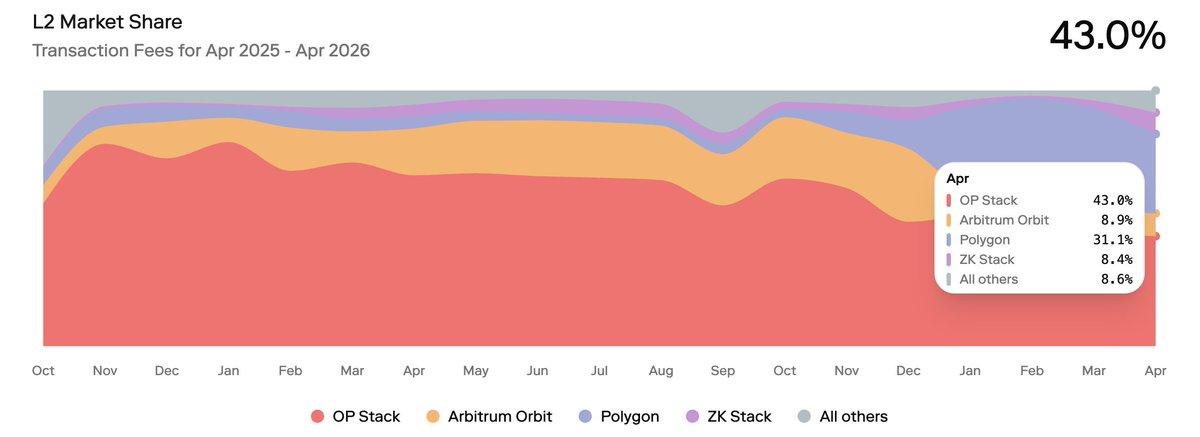
Over the year ending April 2026, OP Stack chains accounted for more than 40% of all Ethereum Layer 2 transaction fees, the largest share of any L2 ecosystem, while processing roughly 17 million transactions per day and holding combined DeFi TVL above $4.8B as of March 31, 2026.
The challenge
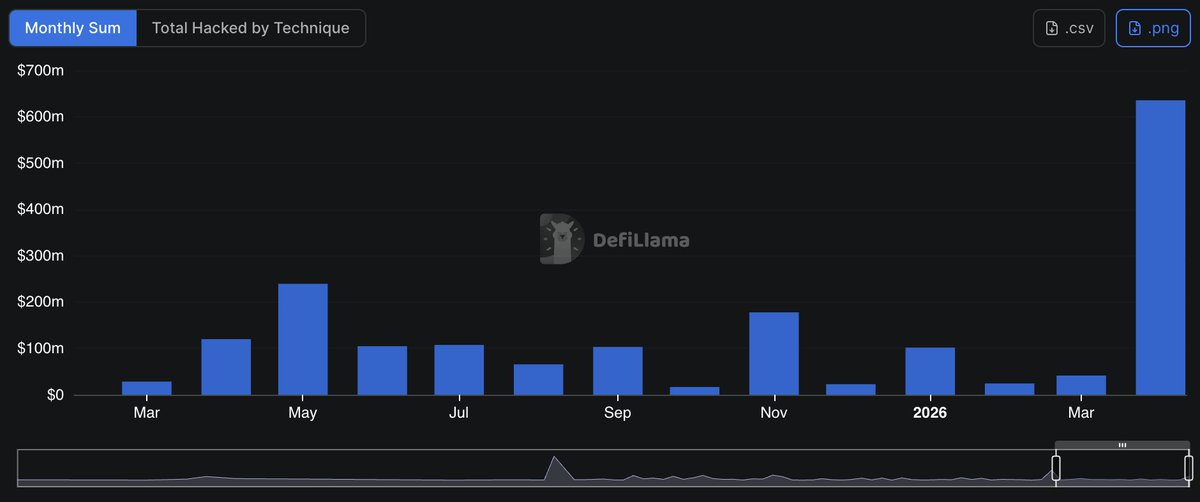
April 2026 was one of the most severe stress tests DeFi has faced to date. Nearly one exploit per day, resulting in over $600M in losses.
Most importantly, the incidents demonstrated the pernicious second-order effects of onchain exploits, which turned into systemic balance-sheet damage for counterparties that were never directly attacked due to protocol interconnectedness.
These incidents were a painful reminder that best practices for onchain treasury management are no different than in traditional finance: risks must be actively mitigated through controls, monitoring, and diversification, and tail risk must be transferred.
Insurance traces its origins to Lloyd's in 1688, and the insurance markets have underpinned virtually every form of large-scale capital deployment since. However, on top of underwriting capacity remaining scarce for onchain risk transfer (and often entirely unavailable), traditional insurance approaches are structurally incompatible with the operational realities of DeFi as they typically require users to:
- Pay premiums upfront for the full policy term, which is inflexible (premiums cannot scale up or down with allocation changes), wasteful (premiums are potentially paid on coverage that is never used), and often both.
- Manage renewals manually, which not only imposes additional overhead but reintroduces an offchain, off-platform dependency into workflows otherwise designed to be onchain composable, and atomic.
- Commit to a fixed coverage duration, typically a year, which is often incompatible with real DeFi usage, where allocations are dynamic and can rebalance multiple times a day, especially in the context of vaults.
- Purchase coverage off-platform through manual brokering, a process that typically takes weeks to months when capacity is available at all.
The result is a trilemma between safety, capital efficiency, and operational feasibility. In practice, most institutional allocators resolve it by sacrificing one of the three: unproductive at best (treating the treasury as a passive balance and forgoing onchain yield entirely) and unsafe at worst (relying on mitigation alone and hoping for recovery when incidents strike).
The consequences
The Optimism Foundation's treasury management team faced three persistent pain points when deploying capital onchain:
- Protecting against tail risk: Operating under an active treasury management mandate, the team needed to put capital to work without leaving catastrophic downside unaddressed. The challenge was finding a mechanism to efficiently transfer the tail risk of active onchain allocations.
- Tracking covered positions: Once capital was deployed, the team needed clear, continuous visibility into what was covered, position value, and whether the protection remained in force.
- Integration into existing workflows: any solution had to work within the team’s existing MPC wallet infrastructure. Activating cover, adjusting an allocation, and unwinding a position needed to happen within the same operational controls that the MPC wallet already provided, rather than reintroducing the off-platform brokering and renewal dependencies that an onchain workflow is designed to avoid.
The Covered Vaults solution
As onchain capital markets mature, they require instruments that embed risk transfer directly at the capital allocation layer.
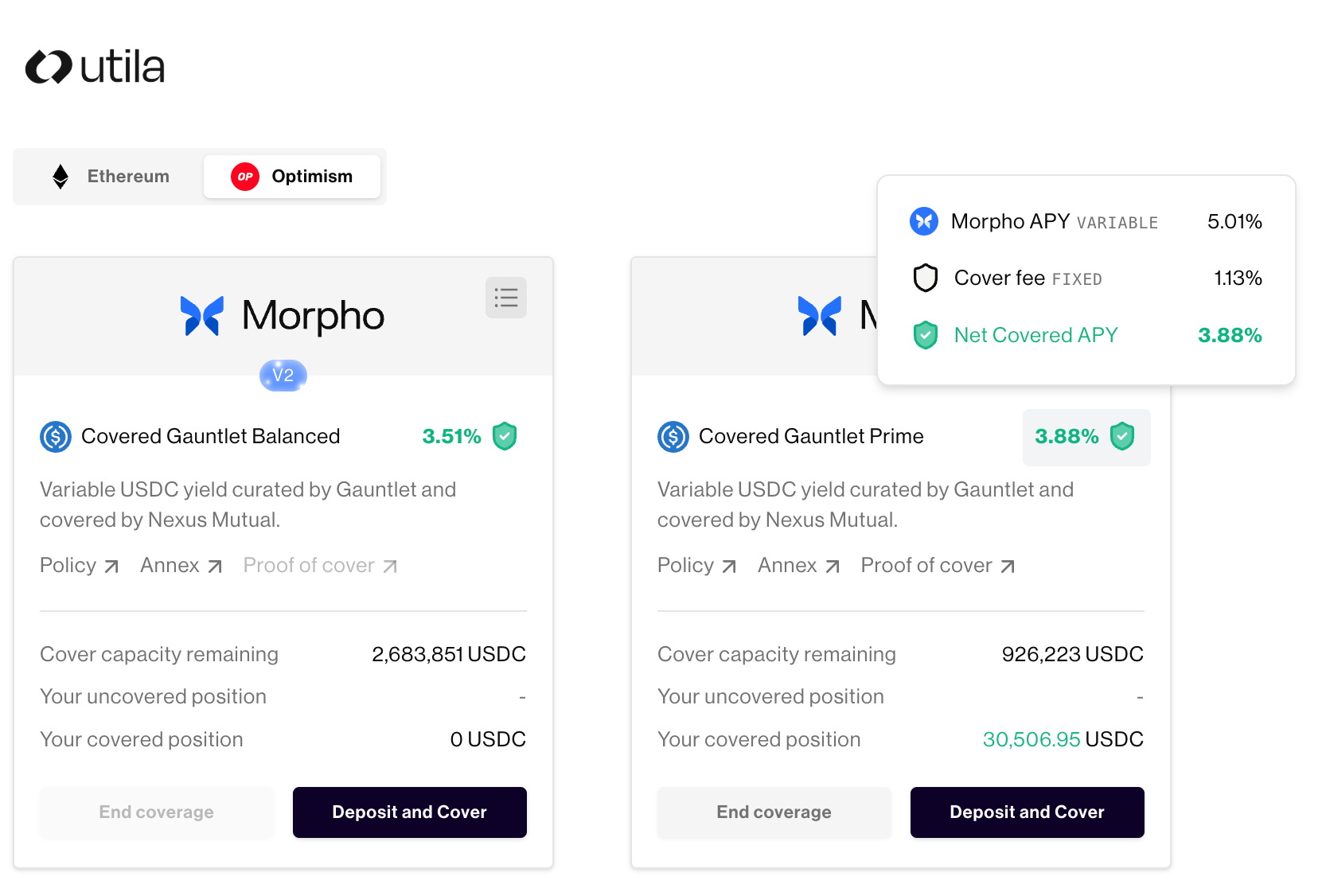
Covered Vaults is a new primitive built by OpenCover in collaboration with Nexus Mutual, Morpho, Utila, Kiln, and 15 further design partners. The primitive embeds cover directly into tokenized vault strategies without changing how users deploy capital. The design objective is to render onchain risk transfer operationally simple, composable, and natively compatible with the way modern treasuries manage capital.
The covered perils span the major technical and economic risks witnessed onchain since 2019: smart contract exploits, oracle manipulation and failure, governance attacks, and bad debt events arising from collateral impairments at upstream protocols. Ultimately, the primitive solves the hardest challenges of bringing insurance natively onchain:
- Cover on demand: Cover can be activated or deactivated at any time on any supported vault position.
- No upfront payments: Cover is not gated by an upfront premium payment; instead, premium is streamed continuously from the underlying vault's yield, eliminating any impact to principal at policy inception.
- No lockups or duration commitments: Cover remains in force only while the position is staked in the Covered Vault, and unwinds the moment the user unstakes.
- ERC-4626 compatible: Covered Vaults integrate with standard tokenized vault infrastructure while remaining extensible to broader vault implementations.
- Real-time, auditable proof of cover: Cover is underwritten through Nexus Mutual's underwriting infrastructure, with proof of cover auditable onchain and underwriting capital provably locked onchain to back payouts.
Outcomes
OpenCover worked with Nexus Mutual, the premier onchain underwriter for DeFi risk, Utila, a leading wallet and digital asset infrastructure provider, and Gauntlet, a leading yield curator with $1.5B across vaults and 150+ live integrations across fintechs and institutions, to curate and deliver a high-capacity Covered Vault on Morpho’s OP mainnet deployment.
The Optimism Foundation made an initial 7-figure allocation to the Covered Morpho × Gauntlet USDC Prime vault on OP Mainnet.
Over the first 24 days of the allocation, the Covered Morpho × Gauntlet USDC Prime vault delivered an average net covered yield of 4.6% APY, inclusive of rewards, decomposed as follows:
- Average net covered APY: 4.62%
- Cover premium (fixed): 1.13%
- Average underlying vault APY (variable): 5.75%
By leveraging Covered Vaults, the Optimism Foundation earned covered yield on its stablecoin treasury at 100 bps over the 1-month Term SOFR with minimal incremental operational overhead.
The full, covered set of technical and economic risks of the underlying Morpho vault was transferred to specialist underwriters in a single onchain action, with the Covered Vault position trackable directly and leading DeFi portfolio trackers such as DeBank.
Why this matters
As treasury capital migrates onchain through the OP Stack and beyond, risk-transfer infrastructure must mature in lockstep with the capital-efficiency primitives that drive this migration.
Covered Vaults overcome the operational complexity that has historically separated DeFi yield from DeFi insurance by embedding cover directly into the capital allocation workflow rather than bolting it on as a discrete, off-platform purchase.
The Covered Morpho × Gauntlet USDC Prime vault on OP mainnet is a testament that integrated risk transfer can sit as a native layer of the onchain yield experience without compromising liquidity, composability, or ease of deployment, ultimately resolving the trilemma between capital efficiency, operational simplicity, and safety that has previously constrained institutional allocators.